
Sustainable Supportive Spaces
Context, Care & Connection
The writing of RESTORE allowed me to dive deeper into the qualities, features and considerations around what makes a planted place ‘restorative’ (what the evidence showed). Since then, I have been fortunate to visit many restorative and therapeutic spaces all around the world, exploring not only what these places look and feel like, but also how they are used, cared for and even funded.
Particularly in my recent trip to Europe – where I visited sites of Garden Therapy in Germany; Nature-based Interventions in Sweden and various sites who were practising Social and Therapeutic Horticulture in the UK – I have come to realise that the creation of a restorative ‘place’ is really only the very start of its life and purpose as a Supportive Space.
In order to remain sustainable in its most basic meaning as a site, there needs to be a long-term holistic plan to ‘manage’ it. (I dislike the terms ‘management’ and ‘maintenance’ as they presently have a transactional and financially-driven connotation, but I recognise this is what is most often occurring in the current extractive capitalist climate.)
When I say ‘sustainable’ at its most elementary, I am not referring to the environmental development that the term has now become synonymous with. I am referring to what the Merriam Dictionary describes as “capable of being sustained” or “maintained at length without interruption or weakening” (sustained). It is about something being created to ‘last’, as the Oxford Dictionary states: “Sustainable is an adjective that describes something able to be maintained or continued at a certain rate or level.”[1]
I would define the meaning of sustainable that I am posing here, as a place having the longevity to be truly long-lasting and capable of being maintained in a reasonable manner for this longer term (in terms of people power, financial investment and general expectation of performance and use).
With this in mind, I have realised that to achieve such sustainability, we need a trifecta of essentials within restorative spaces to make them enduringly supportive = Context; Care & Connection.
Before I go into detail of the Sustainable Supportive Space trifecta, I would like to also refer to the “triple bottom line” that this entails, which comes from the global development models of sustainability. Despite being opposed to the financial / economic lens being the driver in such situations, it is interesting to note the trifecta may still cover all bases, when the areas are indeed equal, as in my interpretation.
A number of sources for economic sustainability work on the 3 P’s: People; Planet and Profit / Prosperity. That means any development or venture should be good for people (e.g. living wages, social benefits); the planet (e.g. not over-extracting from or damaging the environment) and Profit (e.g. that the business can continue to run – or in the greedy sense make profit, an economic focus).[2]
On a broader level, citing the 1987 World Commission on Environment and Development, sustainability is about “…development that meets the needs of the present without compromising the ability of future generations to meet their own needs.”[3] That’s a vision we should always be keeping in mind and which sits more closely to indigenous thinking of the 7 Generations model (that people in seven generations – c. 150 years – should still benefit from our present actions).
So, with these models of sustainability as a starting point, here is a go at explaining my version of it by introducing the 3 C’s of Sustainable Supportive Spaces = Context; Care & Connection.
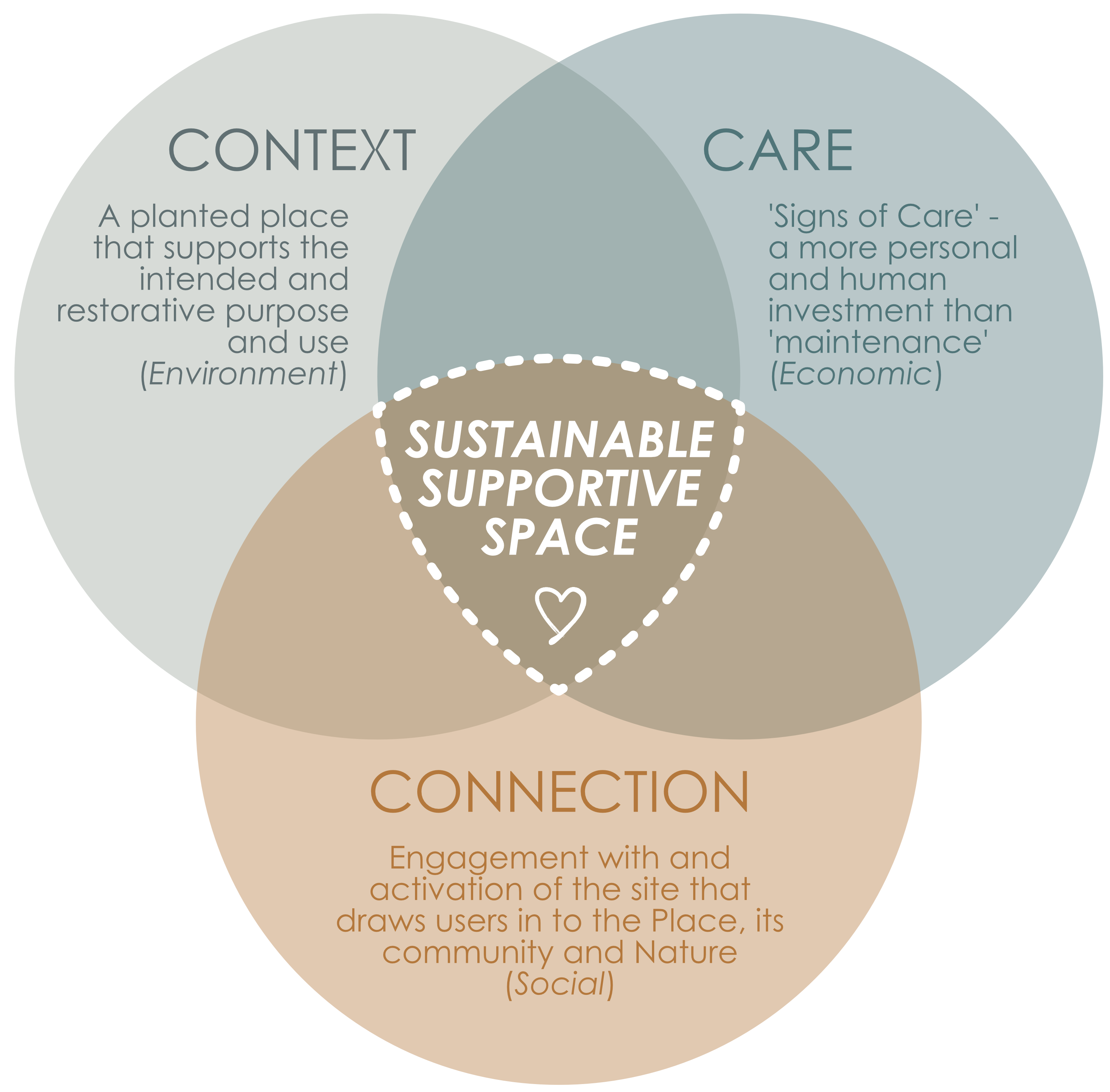
CONTEXT: ‘A planted place that supports the intended and restorative purpose and use’. As per the universal design considerations of RESTORE, if a place does not have spaces that utilise the evidence-base and support restoration, then it may have little therapeutic effect. Of course. Including the RESTORE considerations within a new design, or evaluating and evolving an existing place according to the evidence can enhance the restorative effect possible within any planted place, regardless of geographical location or type of space. These considerations can (and potentially should) be tweaked and adjusted as user cohorts and needs evolve or change. Planted places are dynamic, they grow and shift naturally, in response to users (think desire lines) and under the curation of gardeners. This provides a great opportunity for flexibility and responsiveness to deeper observations over time. (Context = Environment / Place in existing ‘sustainability’.)
CARE: ‘Signs of Care – a more personal and human investment than ‘maintenance’’. This is about raising the level of care and upkeep to move beyond a financial or economic focus and invest in a more crafted and dedicated manner in both people and place for the long-term benefit of all. It does not have a focus of efficiency or reduction of time taken for care, it is about investing the time (and money) for dedicated roles, knowledge and skills. Care builds human and place relationships that ‘maintenance’ often cannot, due to tight time-frames or methods of practice (a leaf blower or other loud (fast/efficient) machinery are not conducive to conversation, for example). Making time for observation, contemplation of response, building of trust and knowledge of a site, its plants and its people is a deeper level of investment in all aspects of the sustainable model. (Care = Economic investment / Prosperity in existing ‘sustainability’.)
CONNECTION: ‘Engagement with and activation of the site that draws users in to the Place, its community and Nature’. An often-used term in Landscape Architecture is ‘program’, alongside the ‘activation’ of a site – these terms can be somewhat superficial (not in their intention, but their execution) and so as with Care, I refer to the building of relationships between people and the planted place. Literally, cognitively and emotionally engaging with a place gives us a sense of belonging, being a part of a greater ecological and social system or Community. We can gain a sense of ‘home’, or at least a sense of self through our role within our surrounding community – encompassing the spatial, human and ecological. Planted places have a unique, and sometimes intangible way of being supportive of relationship building, as easy places for talking and simply ‘being’ together, without demanding many of the things other social situations or contexts would of us. That makes them a vital place in which to combat social isolation, as well as the isolation from Nature (remembering We ARE Nature). Offering opportunities, curated moments or prompts for people to engage with a place alongside others, or on their own, is something we are in quite desperate need of in current times I would wager. (Connection = Social / People in existing ‘sustainability’.)
I believe that in a similar way to the development model of sustainability, the concepts of CONTEXT; CARE & CONNECTION cover all we need to create long-term Sustainable Supportive Spaces. By addressing all three areas, we can ensure that the economic future (through Care) is invested in, the dynamic use of a place continues to evolve as per user needs (as a dynamic Context) and that the relationship building with both people and place can be strengthened and deepened (as personal Connection).
Although the creation of a new garden, park or green rooftop is exciting, without a focus on all three essentials of sustainability, we are basically planning for these sites to have a limited life-span at best, and to fail quickly through disuse or vandalism at worst. Attending to Context, Care and Connection is planning for future generations, who can thereby not only continue to use such Supportive Spaces, but adapt them for their own needs without having to ‘start again’. Let us create Sustainable Supportive Spaces that can support (and even improve) daily lives and restoration. By being truly ‘sustainable’, planted places can continue to play the important role of which they are capable, in the best way possible.
[1] The Cambridge Dictionary also describes it as: sustainable “able to continue over a period of time” or “able to be maintained or continued”; both dictionaries also relate this to the terms “lasting” and “prolonged”
[2] https://learninglab.rmit.edu.au/university-essentials/sustainability/systems-thinking/triple-bottom-line/
[3] “Our Common Future” Report, which is also known as the Brundtland Report after the Commission’s first chair, then Prime Minister of Norway, Gro Harlem Brundtland.
Hi Sandra, Thank you for another thoughtful piece. This is quite timely as I am involved in supporting a garden project which is struggling to find its way at the moment and this nicely articulates and provides language for issues we are dealing with.
I hope all is well with you.
Colin