
All the Stress Rehab Gardens from my Thesis have ‘gone’ – why are they not being valued? And why do I still maintain hope for the future of restorative green spaces?
Before I set off on my Garden Therapy-focused trip to Europe in May this year, I had been in a bit of a lull – nothing serious or particularly existential, just a little tired of the barrage of bad news, evil-doings, selfishness and earthly neglect, I expect. The things we seem to all be dealing with (if not more) on a daily basis at present.
However, I came back from the trip with some clear ideas of what steps I hope to take next, practical approaches to what I feel could be real progress in enhancing the value of green spaces across the world and making a positive difference in the lives of many. I was simply inspired by the great people I met, doing wonderful things. That is the magic of green spaces, gardens and Nature. And with so many champions of Mother Nature, who help us connect with her, I have been refilled with hope.
In sharing these two ‘moods’, I am reflecting on the feelings and feedback shared with me by others recently, friends who have directly asked me if I am seeing a positive change and something to be truly hopeful for. So, I felt it was timely to respond with some ponderings of hope and positive energy – perhaps we could all use them at the moment.
And while I can be as good a cynic as anyone, I do indeed hold onto hope – as Australian author and activist Hannah Maloney recently (roughly) said in an interview: you don’t just stop because things get hard, you keep going because you believe in what you are doing.
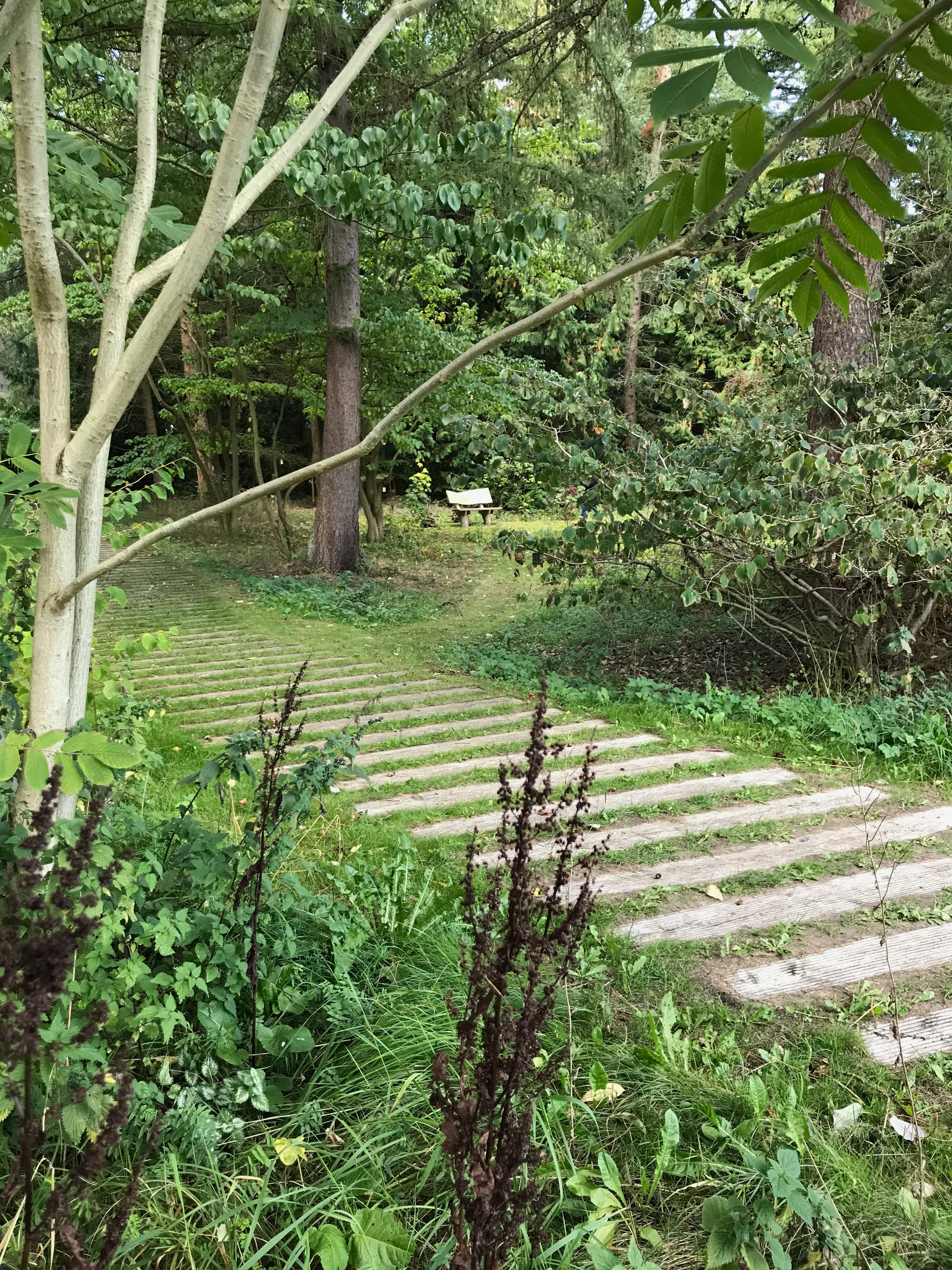
In reference to the sub-heading of this article, all three of the stress-rehabilitation gardens I presented in my Swedish Master Thesis (2019) have since closed. One literally the week that I presented the thesis, the second just a few months later and the final one, earlier this year. These situations are disappointing to say the least, actually quite devastating in truth, particularly as two of them (Alnarp Rehabilitation Garden and the Healing Forest Garden Nacadia) were tightly linked to university research as living laboratories.
Therefore, it was no surprise that a fellow landscape architect challenged me during a presentation in Glasgow, to question where I saw hope in these developments and challenges. Where and why should the people I was presenting to, draw strength and hope from, when important sites such as these were closing? Fair. Call.
On top of this, I found during this trip that the fantastic programs helping people with chronic stress in Sweden, are not allowed to do so until the participant has been out of work for two years. No, you may not help them after one year, to get them back on track sooner, they must suffer for a further 12 months before they are eligible for the support that Green Rehabilitation can offer. Really?!
Right, so it’s time to give up on any expectation of ‘common sense’ – it is after all not very common anymore. Top this off with our blind rushing towards the AI revolution, digital relationships and removing ourselves from all things that are truly human and we seem to be on a freight train without a driver – cue the myth of mindless lemmings racing towards over the cliff edge.
Mmmmm…from where then, comes the hope? Well, it’s in all the programs, planted places and people who are still going. Who haven’t stopped just because it is frustrating, or hard, or complex. Who keep going because they see and focus on the difference their work – and the green spaces in which it happens – are making. The people who keep going because they have full faith in the magic of planted places.
These inspiring individuals turn up with a smile and an attitude of “why not”? They often volunteer, they give generously of their time and their personal energy – both to their participants, and to me when I was lucky enough to visit. And as Australian academic and all-round good egg Kate Neale (Researcher in Childhood Studies and Disability Studies) reminded me recently, the magic lies in caring ABOUT people, not only FOR them [Honneth’s Recognition Theory].
There are certainly many times (a day) where I am frustrated at what feels like the glacial speed of progress in this field, the dismissal of the benefits of what we all know (Nature heals us) and the societal devaluing of Nature – be that extractive or more subversive. BUT…the topic of reconnecting with Nature – because we ARE Nature – or the benefits of spending time outdoors, the wellbeing we gain from engaging with our local environment and community ARE being discussed more and more often and broadly.
Various people have shared with me the diverse spaces and platforms on which they see this topic being discussed, especially in the mainstream media – which is fundamentally hopeful to me. I may prefer that people would deep dive more fully into what a Sensory Garden is or could be, for example, but even if the term is being used as jargon, or due to being a ‘trend’, people are still talking about it. Which means it is a step forward in normalising these concepts. And that IS progress.
It is a raising of awareness, focusing the lens on the topic for more and more people to see and recognise as something normal, positive, supportive and restorative. I’m not talking about convincing people that ‘gardening is great’ here, I mean connecting people to the outdoors, to plants and to Nature. (Start small and build on the inevitable successes and benefits that will follow.)
The way we have been communicating these benefits has not quite been getting through, perhaps being drowned out in the dominant competition of entertainment through digital media. It is obvious though that the depletion, the separation and the unhappiness that these technological tools bring with them when overused are directly affecting our global mental health.
Thus, sharing and trying something different, like taking a walk in a park, planting a tree, pruning a shrub, weeding, smelling a rose, watching an insect pollinate your balcony flower…are worth a try. Reach people by getting back to basics, connecting with place, others and yourself.
I have come to realise in writing this piece, that this is my personal version of FAITH. It is unrelated to religion, but rather a faith that it is possible to reverse the impacts of extractive capitalism and return to each other and our local environments – to our proverbial ‘village’. And don’t get me wrong, I’m not being Polyanna, in fact I think a lot of human behaviour makes us the scum of this planet. Yet I still continue to try to improve the situation. Not unflappable, just determined. Perhaps I’m just stubborn!?
The reason I use the term FAITH is based on a feeling deep inside me, somewhere. I have not a shadow of a doubt that Nature is filled with magic. Nature can restore us in a way that no other type of space can, it is deeply connected within us all – evolutionary if you like. We all know it and prove it every time people get up at unseemly hours to witness a sunrise, or bask in the awe of a sunset, enjoy surfing a wave, or stare at clouds in a vibrant blue sky, or squeal at the first sighting of a blue-banded bee. We just need to let the magic ‘in’, give it space and value in our lives.
So, when friends have asked recently do I see change happening – I do! It’s not just my own little bubble, though surrounding myself with like-minded people is a supportive strategy that buoys. Capitalist vitriol aiming to destroy societal democracy tries to convince us we are ‘too small’, ‘too powerless’ and ‘alone’ to combat these challenges – we are NOT. Believing it gives them fuel, when in fact the easier act is to take one (small) step forward, doing the right thing towards truly valuing planted places. It is through the small actions, the personal offerings, that we really make a difference by living it and being an example of the alternative.
I have been visiting, meeting and learning from people and places because I want to be part of the ‘inspiration’. I do these things because they feel right to me, not to be performative or as an act of ‘networking’, but because they are part of my belief that Nature reconnection is the answer. I don’t have kids to pass this planet onto, so I do these things because I feel they are right, fair and good. This is what rejuvenates me – faith and belief in simply doing them for the right reasons.
How then do we tackle that great task that my mentor and friend Steven Wells placed upon me – to increase the value the world sees in Nature / Planted Places? We need these spaces to touch people personally. It is not enough to ‘tell’ people (I know, I have ignored much of my parents’ advice throughout my life!), we all need to experience reconnection with Nature. Research evidence has not been enough, translating the concept into $ worth has not yet worked enough…we need to find a way for more people to experience it personally, internally.
As I said to some Swedish colleagues, we may just need the ‘right’ person to get sick (and healed by Nature) to turn the tide. If the ‘right’ powerful advocate and voice at the table got ‘sick’ and felt the difference these complementary therapies and planted places provide, perhaps that would increase the value people see in them. But let’s also imbed them in every day life and our societal expectations of wellbeing.
In the most recent session of the new semester-long course of Therapeutic Landscapes (UniMelb, Burnley) we discussed the balance required within research, to offer both data and narrative. We have plenty of scientific evidence, which needs to be balanced by the emotional engagement that drives at the core of our humanity.
Let’s also stop using aggressive, violent and warring words to describe Mother Nature. She is not spiteful or evil in the events she is sending our way, they are a REaction to OUR actions. WE have caused climate change and its consequences, not Nature. While these responses are terrifying, they also demonstrate that it is within our scope to change and improve the situation, IF we want to. But this is not a call for climate change activism or getting back to the overwhelm of cut landscape budgets, natural disasters and economical mayhem that has seen the Stress Rehabilitation gardens of my thesis close.
Let’s embrace regenerative models (of agriculture and economics, for example), make individual choices that protect the earth and share the planted places for which we care with others. On a personal level, let’s prioritise spending time in Nature, looking at the details of a flower, savouring the taste of a locally grown morsel, watching an insect explore their habitat.
Zoom right in, to where the globe and all its ‘noise’ is no longer the focus – but instead focus on what you are living, experiencing and sharing with another life-being RIGHT NOW! Share the joy, share the awe, share Nature with the ‘being’ nearest to you, and have faith that it WILL have a positive and hopeful effect - on you and others.
I teach the Diploma of Landscape Designs and in a subject called Specialised Landscapes, the students have the option to design a Therapy Garden. Last year I had two guys who had previously completed a Landscape Apprenticeship, both chose to design a therapy garden for their partners who work in high stress jobs. One of them will be actually built. I was so chuffed that pragmatic landscapers valued the benefits of garden as therapy. It bodes well for a bottom up approach. And, of course, I reference you in my teaching - your book is on the list!
Thanks for this Sandra. The hopeful realism resonates and is thought provoking and motivating.